/ Lake Stevens, WA
Aerobic treatment unit maintenance in Lake Stevens.
Many Lake Stevens homes near the lake and on small lots use aerobic treatment units (ATUs) because the soil cannot handle a standard drainfield. ATUs treat wastewater better than a plain tank, but they need regular care to keep working.
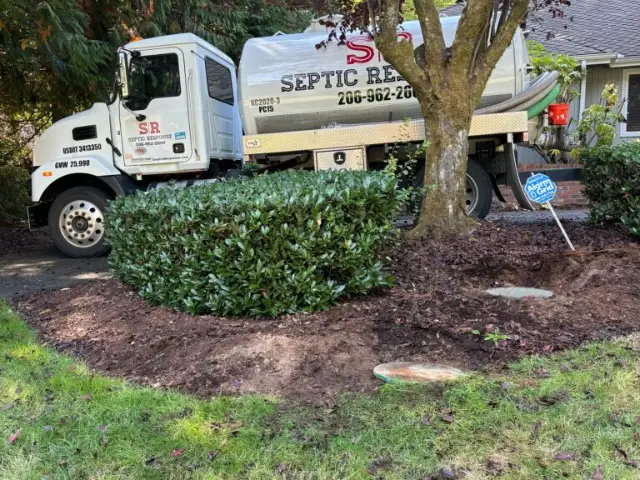
An aerobic treatment unit (ATU) is a small treatment plant in your yard. Instead of relying only on the soil to clean wastewater, it pumps air into the tank so oxygen-loving bacteria can break waste down faster and more completely. ATUs are often used where the soil, the water table or the lot size will not support a standard drainfield, which is why you see them on many properties around Lake Stevens and across Snohomish County. They work well, but they need more care than a basic gravity system.
How an ATU works
- Wastewater settles in a pretreatment chamber, where solids sink and grease floats, much like a regular septic tank.
- A compressor pumps air into an aeration chamber, where bacteria break down waste.
- A clarifier lets remaining solids settle and returns them to be treated again.
- Some units disinfect the water before it goes to the drainfield or drip lines.
Because every stage depends on moving parts (the compressor, pumps, floats and the alarm), an ATU that is ignored tends to fail suddenly rather than slowly.
What maintenance involves
Snohomish County inspects alternative systems like ATUs every year unless the manufacturer requires more often. On each visit we check the compressor and diffusers, alarms and floats, pumps, filters and the effluent quality, and pump the tank when the measurements call for it. We service Oscar, Bio-Microbics and other brands.
A typical annual service visit includes:
- Compressor and air supply. We confirm the compressor is running, check its air filter and make sure air is reaching the diffusers. Weak aeration is the most common reason an ATU starts to smell.
- Sludge and scum levels. We measure each chamber and pump only when the levels say it is time.
- Pumps, floats and alarm. We test that the pump turns on and off at the right levels and that the alarm sounds when it should.
- Filters. Effluent filters are cleaned or replaced.
- Effluent quality. Clear, low-odor effluent tells us the bacteria are doing their job; cloudy or smelly effluent tells us something upstream needs attention.
- The county report. We file the inspection report with the county, so your records stay current.
What you can do between visits
- Never turn off or unplug the compressor. Some owners do because of the hum. Without air, the bacteria die and the unit starts sending poorly treated water to the drainfield.
- Keep the compressor’s air intake clear of plants, mulch and snow.
- Go easy on harsh chemicals. Large amounts of bleach, drain cleaner, antibacterial products and medications can kill the bacteria the system relies on. Normal household cleaning is fine.
- Watch what goes down the drain. Wipes, grease and food waste make ATUs work harder. Our what not to flush list applies double for aerobic systems.
- Spread out water use, especially laundry. Big surges push water through before it has been treated.
- Know where your alarm panel is, and call when it sounds. After a power outage, check that the compressor restarts; our power outage guide covers what to do.
Warning signs
- An alarm that will not clear
- A compressor that runs nonstop or not at all
- Strong sewage odor
- Wet or spongy ground over the drainfield
- Slow drains or backups
Call us if you notice any of these. Catching a failing compressor or pump early is far cheaper than repairing a drainfield that has been flooded with untreated water.
Saving money on ATU care in Snohomish County
The Snohomish County Health Department’s Savvy Septic program offers rebates for inspections, pumping, risers and select minor repairs, plus financial help for major repairs, for eligible homeowners. Taking the free online Septic Care Workshop makes you eligible. Our maintenance plan also keeps your annual visits on schedule so you never miss a required inspection.
More on ATU, Oscar and Bio-Microbics service and our Lake Stevens septic service. Call (206) 790-9392 or (206) 962-2600; we answer 24/7.
Related: Buying a home with an aerobic treatment unit
Quick answers
How often does an aerobic treatment unit need service in Snohomish County?
Snohomish County expects alternative systems such as ATUs to be inspected every year, unless the manufacturer requires more often. Pumping is done when the measured sludge and scum levels call for it.
Can I turn off my ATU’s air compressor?
No. The compressor supplies the oxygen the bacteria need. Without it, the unit stops treating wastewater properly and can damage the drainfield.
Why does my aerobic septic system smell?
The most common causes are weak or failed aeration, a tank that needs pumping, or harsh chemicals that have killed the bacteria. Have the compressor and diffusers checked first.
Do you service Oscar and Bio-Microbics units?
Yes. We service Oscar, Bio-Microbics and other aerobic treatment unit brands across Lake Stevens and Snohomish County.