
/ Service
Sewage ejector & grinder pumps in King & Snohomish County
Sewage ejector and grinder pump repair, replacement and installation for homes in every city across King and Snohomish County. When your home sits below the sewer or too far from it to drain by gravity, we keep the pump that gets it there working. Phones answered 24/7.
Pump alarm going off?
We answer 24/7
Stop using the drains that feed the pump, check the breaker, then call.
Kirkland (206) 962-2600
Woodinville (206) 790-9392
/ Sewage ejector and grinder pumps
Short answer: a sewage ejector pump or a grinder pump moves wastewater from your home up or out to the public sewer when gravity can’t do it. Septic Response repairs, replaces and installs both kinds in every city we serve in King and Snohomish County. We’re family owned and in business since January 2017, the owners answer every call, you get the price before we start, and we stand behind the work with the Septic Response Promise.
- What we do: pump and float repair, check valves, alarms and control panels, full pump replacement, basin cleaning, and new ejector or grinder systems for septic-to-sewer conversions.
- Where: every city in both counties. King County calls go to our Kirkland office, (206) 962-2600; Snohomish County calls go to Woodinville, (206) 790-9392. Both answered 24/7.
- Alarm going off now? Stop using the sinks, toilets and laundry that drain to the pump, check the breaker, and call. See what to do right now.
- Pricing: we look at the pump, the basin and the run before quoting, and you get the number before any work starts.
What does a sewage ejector or grinder pump do?
Most homes send their wastewater to the sewer by gravity. The side sewer slopes downhill from the house to the main in the street, and everything flows on its own. That only works when every toilet, shower and washer in the house sits higher than the sewer main, and when the run is short enough for the pipe to keep its slope.
When that isn’t true, the wastewater needs help. A sewage pump sits in a sealed, vented basin at the low point of the plumbing. Drains flow into the basin by gravity. When the level rises, a float switch turns the pump on, and the pump pushes the wastewater through a discharge line and a check valve up to the gravity side sewer or straight to the main. When the level drops, the pump shuts off and the check valve keeps the line from draining back.
There are two kinds of sewage pump in homes around here, and they solve slightly different problems.
Sewage ejector pumps
An ejector pump lifts sewage with the solids intact. It is the usual answer for a basement bathroom, a lower-level laundry, or a daylight-basement suite that sits below the side sewer. It moves a lot of water at relatively low pressure, into a short discharge line that ties into the gravity side sewer a few feet higher. It is simple, sturdy and fairly forgiving.
Grinder pumps
A grinder pump has a cutter at the intake that shreds solids into a fine slurry, then pushes it at higher pressure through a small-diameter pressure line, often 1¼ to 2 inches. That pressure is what lets a home far back on a lot, at the bottom of a steep driveway, or well below the street send its wastewater to the main without a long, deep gravity trench. Some sewer districts also use low-pressure sewer systems, where each home on a street has its own grinder pump feeding a shared pressure main.
Ejector pump or grinder pump: which one does your home have?
| Sewage ejector pump | Grinder pump | |
|---|---|---|
| Typical job | Lifts a basement bathroom or laundry up to the side sewer | Sends a whole home’s wastewater a long way or far uphill to the main |
| Solids | Passes them whole | Grinds them into slurry |
| Discharge line | Larger pipe, short run | Small pressure line, long runs possible |
| Pressure | Lower | Higher |
| Tolerance for wipes and grease | Better, but not immune | Low: wipes and grease wear the cutter and jam the pump |
| Where you see it | Basement and lower-level suites, daylight basements | Homes below the street, long driveways, septic-to-sewer conversions, low-pressure sewer neighborhoods |
Not sure which you have? Look for a round basin lid in the basement floor, a crawl space or the yard, a small control box or alarm on a wall or post nearby, and a pipe leaving the basin with a valve on it. Tell us what you see when you call and we’ll usually know before we arrive.
Why so many homes in King and Snohomish County have one
Puget Sound country is hills, ravines, bluffs and lake shores, and the sewer mains run where the streets are. A lot of homes simply sit lower than the main or a long way from it. These pumps are in every city we serve; these are the situations we see most:
- View homes below the street. Bluff and hillside lots where the house steps down toward the water, like the view neighborhoods of Edmonds, Mukilteo, Woodway, Shoreline and Burien, often pump everything up to the street.
- Daylight basements and lower-level suites. The split-level and daylight-basement homes all over Kirkland, Bellevue, Sammamish, Bothell and Lynnwood usually have an ejector pump under a basement bathroom or laundry.
- ADUs and basement remodels. A new bathroom below the side sewer means a new ejector pump. If the house is on septic instead, the bathroom also changes the system’s design load, which our septic inspections team can check before you build.
- Septic-to-sewer conversions. When a home that has been on septic connects to a new sewer main, the house is often set back, downhill or across a slope from it. A grinder pump and a small pressure line is often the practical way to connect. We handle that as part of a side sewer installation, including pumping and decommissioning the old tank.
- Lake and river lots. Homes that sit down near the water around Lake Stevens, Lake Sammamish in Issaquah, and the lakes of Redmond and Kent are often below the road.
- Rural acreage near sewer. Long driveways in places like Maltby, Mill Creek and Woodinville can put the house hundreds of feet from the nearest main.
Signs your sewage pump needs repair
- The high-water alarm is sounding, or its light is on.
- Sewage odor near the basin, in the basement or in the yard near the lid.
- Lower-level toilets, showers or floor drains are slow, gurgle or back up.
- The pump runs nonstop, cycles on and off every few seconds, or never seems to run at all.
- A tripped breaker or GFCI on the pump circuit, especially one that trips again after you reset it.
- Grinding, rattling, loud humming or a pump that hums but moves no water.
- Water or sewage around the basin lid, or a lid seal that has failed.
- A pump more than about ten years old that has started acting up.
Most of these are early warnings, not disasters. Caught early, the fix is often a float, a check valve or a cleaning instead of a whole pump.
Alarm going off? What to do right now
- Stop sending water to the pump. No laundry, showers, dishwasher or flushing on the fixtures that drain to the basin. The basin only holds a limited reserve above the alarm level.
- Silence the alarm, don’t unplug the pump. Most alarms have a silence button. The pump and alarm are usually on separate circuits; leave the pump powered.
- Check the breaker or GFCI. If it tripped, reset it once. If it trips again, leave it off and call us; that usually means a failing motor or a wiring fault.
- Don’t open a sewage basin yourself. Sewer gas and raw sewage are a real health hazard.
- Call us. Kirkland (206) 962-2600 or Woodinville (206) 790-9392, answered 24/7. Tell us what the alarm, the breaker and the fixtures are doing.
If sewage is already coming up into the house, it is an emergency. See our 24/7 emergency service.
Sewage pump repairs we do
We troubleshoot the whole system in order, from the breaker and control panel to the float, the pump, the check valve and the discharge line, so you pay to fix the actual problem. The repairs we make most often:
- Floats and level switches that stick, tangle with the power cord, fill with water or simply wear out. The most common reason a pump never turns on or never turns off.
- Check valves that let wastewater drain back into the basin, so the pump short-cycles and wears out early.
- High-water alarms and control panels: failed alarms, bad contactors, corroded connections and timers on duplex systems.
- Jammed pumps and grinder cutters clogged with wipes, rags, grease or debris. Sometimes cleaning frees them; sometimes the impeller or cutter is damaged.
- Worn or burned-out pumps replaced with a unit sized for your lift height, run length and flow.
- Basin problems: grease mats, heavy buildup, cracked basins, and lids or gaskets that no longer seal against odor.
- Discharge line and valve leaks between the basin and the side sewer.
Most repairs come with the Septic Response Promise: a one-year warranty, and if you call about work we have done, we are there the next day if not the same day.
Recent sewage ejector pump replacements
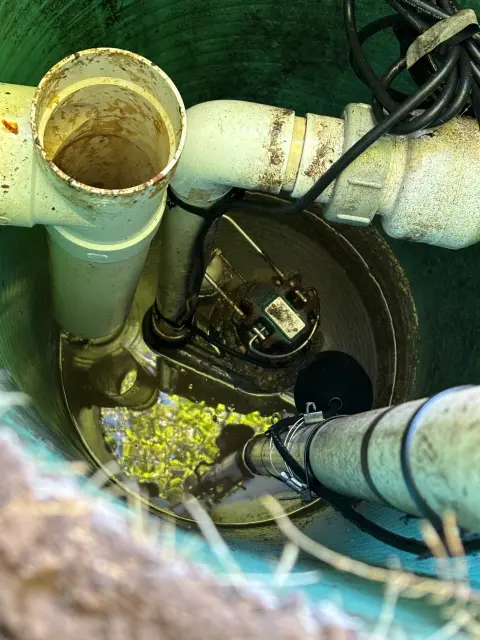
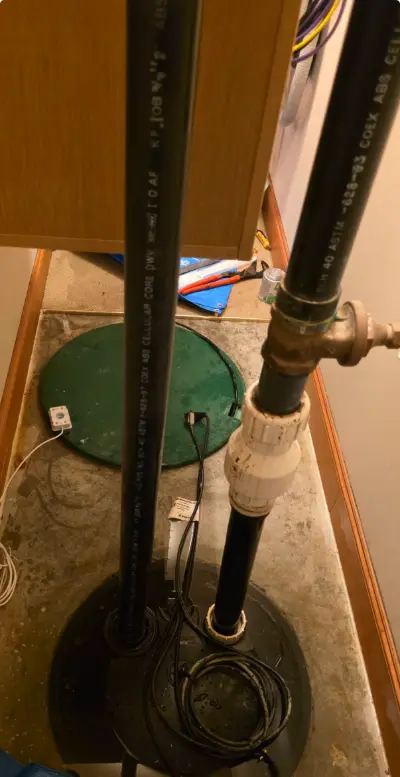
Two recent ejector pump replacements by our crew. On the first, the basin sits below grade with the pump and float at the bottom and the discharge line rising to the side sewer. On the second, the basin is set into a basement floor under a sealed lid, with the discharge line, a union and a valve on the way up to the house drain, and a separate vent.
Repair or replace?
Many residential sewage pumps give somewhere around seven to ten years of service, sometimes much more, depending on how hard they work and what goes down the drains. Age alone isn’t a reason to replace one. These are the questions we walk through with you:
- Is the pump itself the problem, or a float, valve or alarm that can be fixed for far less?
- Is the motor drawing too much current, overheating or tripping the breaker? That usually means replacement.
- Has it jammed repeatedly? A grinder pump that keeps jamming may be undersized, or something in the house is sending it wipes or grease.
- Was the original pump sized correctly for the lift and the run? Some older installs never were, and they wear out early no matter what.
- For a pump near the end of its life, does it make sense to replace it on your schedule now instead of at 2 AM later?
We give you the options and the prices for each, and we don’t push a replacement you don’t need.
New pump installations and septic-to-sewer conversions
We install new sewage ejector and grinder pump systems: the basin, pump, float controls, check valve and shutoff, high-water alarm and the discharge connection. Typical jobs are a new basement bathroom or ADU below the side sewer, a failed basin that needs replacing, and homes converting from septic to sewer that can’t drain to the new main by gravity.
On a conversion, the pump is only one part of the job. We are licensed to install side sewers and help with the permit from your city or sewer district, then pump the old septic tank and decommission it properly with the county report. One crew, one schedule, and nothing left buried in the yard for the next owner to find. See side sewer installation and septic-to-sewer connections, and if you are weighing the switch on a home you are buying, read septic vs. sewer before you buy.
Sizing a pump correctly
A sewage pump has to overcome the vertical lift from the basin to the highest point of the discharge line, plus the friction of the whole run, and still move enough flow to keep solids from settling in the pipe. Too small and it runs constantly and burns out; too big and it short-cycles. We measure the lift and the run, look at the fixtures it serves, and match the pump to the job instead of to whatever is on the shelf.
What not to flush when your home has a pump
Pumps are where bad habits catch up with a house. Grinder pumps especially are built to handle human waste and toilet paper, and not much else. Keep these out of every drain that leads to the pump:
- Wipes of any kind, including the ones labeled “flushable”
- Paper towels, tissues and feminine products
- Grease, fats and cooking oil
- Dental floss, hair and cat litter
- Medications and harsh drain cleaners
Our guide to what not to flush was written for septic systems, and every word of it applies to sewage pumps too.
Keeping a sewage pump healthy
- Test the alarm a few times a year with its test button, so you know it works before you need it.
- Listen for the pump cycling normally after a shower or laundry load. Changes in sound or run time are early warnings.
- Have it checked every year or two: float action, check valve, amp draw, and a look at buildup in the basin.
- Clean the basin when grease or debris builds up, before it fouls the floats.
- Plan for outages. A pump stops when the power goes out. See below.
Homes that are on septic and also have an ejector or effluent pump can bundle the pump check into a regular septic maintenance service visit.
Power outages and sewage pumps
When the power goes out, a sewage pump stops, and the basin can only hold so much. During a windstorm outage, keep water use to a minimum on the fixtures that drain to the pump: no laundry, short showers, and flush only when you have to. Some homeowners add a generator inlet or a battery backup for the alarm. When the power comes back, watch for the pump to run and the alarm to clear. Our power outage guide covers more.
Who is responsible for the pump: you or the sewer district?
Usually the homeowner. An ejector pump and its basin are part of the house plumbing, and a private grinder pump that pushes into a gravity main is the owner’s to maintain. Some low-pressure sewer systems are different: the sewer district may own or maintain each home’s grinder pump. If you are on a low-pressure system, check with your district first. If the pump is yours, we can help.
Sump pumps are different
A sump pump moves groundwater and rainwater, not sewage, out of a crawl space or basement sump to keep the house dry. We install and replace sump pumps too. One rule matters a lot for homes on septic: sump and drainage water should never go into a septic tank. Clean water overloads the tank and floods the drainfield, and many sewer utilities don’t allow it in the sanitary sewer either.
Septic systems have their own pumps as well. The effluent pump in a septic pump chamber doses treated effluent to a pressure or mound drainfield; see effluent pump replacement. We service all of them.
Ejector and grinder pump service in every city we serve
These pumps are in homes in every city in both counties, on sewer and on septic. King County calls go to our Kirkland office, (206) 962-2600, and Snohomish County calls go to our Woodinville office, (206) 790-9392.
King County
Kirkland · Bellevue · Redmond · Sammamish · Issaquah · Woodinville · Cottage Lake · Seattle · Shoreline · Newcastle · Renton · Kent · Auburn · Federal Way · Burien · Tukwila · SeaTac · Covington · Maple Valley · Hobart · Duvall · Carnation · Fall City · Snoqualmie · North Bend
Snohomish County
Bothell · Everett · Edmonds · Lynnwood · Mukilteo · Mountlake Terrace · Brier · Woodway · Mill Creek · Martha Lake · Silver Firs · Eastmont · Maltby · Clearview · Snohomish · Machias & Three Lakes · Lake Stevens · Marysville · Tulalip · Arlington · Stanwood · Granite Falls · Monroe · Sultan · Gold Bar · Index · Darrington
Why homeowners call Septic Response for sewage pumps
- The owners answer every call, day or night, and tell you honestly whether it can wait until morning.
- Transparent pricing. You get the price before we start, and the options if there is more than one way to fix it.
- We stand by our work. Most repairs carry a one-year warranty, and if you call about work we have done, we are there the next day if not the same day.
- Septic and sewer under one roof. Because we are a septic company that also does side sewers, we understand the whole path from your fixtures to the main or the drainfield.
- Family owned since 2017, with offices in Kirkland and Woodinville and 275 Google reviews across both.
Have a pump question or a pump that isn’t acting right? Call Kirkland at (206) 962-2600 or Woodinville at (206) 790-9392, or schedule service online. For septic system problems, see septic repair.
/ Where
Serving both counties.
Our Kirkland office covers King County and our Woodinville office covers every city in Snohomish County.
/ FAQ
What is a sewage ejector pump?
A pump in a sealed, vented basin that lifts wastewater, solids and all, from fixtures below the sewer line, such as a basement bathroom or laundry, up to the gravity side sewer. A float turns it on when the basin fills.
What is a grinder pump?
A sewage pump with a cutter that grinds solids into a slurry and pushes it through a small pressure line. It lets a home that is far from the sewer main, or well below it, connect without a long, deep gravity trench.
What is the difference between an ejector pump and a grinder pump?
An ejector pump moves sewage with the solids intact over a short lift into a gravity side sewer. A grinder pump shreds the solids and pumps at higher pressure through a smaller line, so it can push wastewater much farther or higher. We repair, replace and install both.
Why is my sewage pump alarm going off?
The basin is filling higher than it should. Common causes are a stuck or failed float, a tripped breaker or GFCI, a failed check valve, a pump jammed by wipes or grease, or a worn-out pump. Stop using the fixtures that drain to it and call us; we answer 24/7.
How long does a sewage ejector or grinder pump last?
Many residential sewage pumps last around seven to ten years, sometimes much longer, depending on how hard they work and what goes down the drains. A failing float or check valve can often be fixed without replacing the pump.
Can I flush wipes if my home has a grinder pump?
No. Wipes, even ones labeled flushable, along with paper towels, feminine products and grease, are the most common reason grinder and ejector pumps jam or burn out.
What happens to my sewage pump in a power outage?
It stops, and the basin can only hold a limited amount. Keep water use to a minimum until power returns, then make sure the pump runs and the alarm clears.
Is the grinder pump mine or the sewer district’s?
Usually the homeowner’s. Ejector pumps and private grinder pumps are part of the house plumbing. On some low-pressure sewer systems the district owns or maintains each home’s grinder pump, so check with your district first.
Do you install pumps when a home converts from septic to sewer?
Yes. When a home can’t reach the new sewer main by gravity, we install the grinder or ejector pump system along with the side sewer, help with the permit, and pump and decommission the old septic tank with the county report.
Do you serve my city?
We work in every city in King and Snohomish County. King County: Kirkland office, (206) 962-2600. Snohomish County: Woodinville office, (206) 790-9392. Both answered 24/7.
Do you install sump pumps too?
Yes. We install and replace sump pumps for crawl spaces and basements. A sump pump handles groundwater only and should never discharge into a septic tank.