
/ Septic emergencies
Septic water in your yard? Do this first.
Wet ground, odors or sewage surfacing near the tank or drainfield is a sign something has stopped working. Here is what to do right away.
By Anthony Wilson, founder · Updated November 2026
Right now
- Stop using water. No showers, laundry or dishwasher, and flush only when you must. Every gallon you send down the drain has to go somewhere, and right now it is coming up in your yard. On pump systems, stopping all water use for 4 to 8 hours keeps the pump from dosing more water onto a drainfield that cannot take it.
- Keep people and pets away from wet areas. Surfacing sewage carries bacteria and viruses. Do not let kids play in the area, and wash your hands and boots if you have walked through it.
- Do not open the tank or climb into a riser. Gases in a septic tank can be dangerous, and old lids can give way.
- Call us. We answer 24/7 at (206) 962-2600 (Kirkland office) or (206) 790-9392 (Woodinville office).
Where is the water coming from?
Where the water shows up is the best clue to what has gone wrong. Before you call, take a look (from a safe distance) and note which of these sounds most like your yard:
- Around the tank lids. The tank is full to the top. That usually means the outlet is blocked (a clogged effluent filter or baffle), the pump has stopped, or the tank is badly overdue for pumping.
- Over the drainfield. Soggy ground, standing water or a strong smell over the drain lines points to a drainfield that is saturated or failing. In our wet winters it can also mean the soil around the lines is full of rainwater.
- Between the house and the tank. A wet spot along that path often means a broken or separated inlet line.
- Inside the house. If toilets and drains on the lowest floor are backing up at the same time, the problem is the tank or the line to it, not one fixture.
Photos help. If you can, take a few pictures and have them ready when we call you back.
Common causes
- A full tank that is overdue for pumping. Sludge and scum fill the tank until solids block the outlet or flow out to the drainfield.
- A clogged effluent filter or outlet baffle. Filters are designed to catch solids, so they need cleaning. When one plugs, the tank backs up even if it was pumped recently.
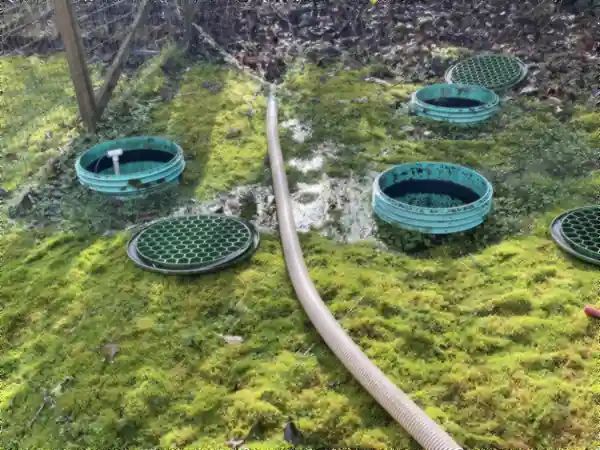
- A failed effluent pump or float on a pressure system. The pump chamber fills, the alarm sounds, and if no one hears it the water eventually surfaces. That is exactly what happened in the photo above.
- A broken or crushed line between the house, the tank, the pump chamber and the drainfield. Roots, settling soil and vehicles are the usual culprits.
- A drainfield saturated by heavy rain, roof or driveway runoff pointed at it, or a drainfield that is simply wearing out with age.
What we do when we arrive
- Find and open the tank. We usually locate a buried tank with a probe. If there is no county as-built on file, or the tank is hard to find, we flush a small transmitter down the line and follow it with an electronic locator.
- Check the levels and the outlet. A tank that is full to the top tells us the problem is downstream; a normal level tells us to look between the house and the tank.
- Pump the tank to relieve the pressure and stop the surfacing. We carry enough hose for every job, so we can reach tanks behind houses, under decks and down long driveways.
- Inspect the parts: baffles, the effluent filter, the pump, floats and the alarm. If needed, we run a camera down the lines to find a break or root intrusion.
- Explain what we found and what it will take to fix it, before any repair work starts.
Most of these problems can be fixed without replacing the whole system. A cleaned filter, a new pump or float, or a repaired section of pipe is far cheaper than a new drainfield. Septic pumping starts at $590, including a tank and baffle inspection and effluent filter cleaning (when the filter is reachable through a lid or riser), plus the county pumping report fee and tax; repair costs depend on what we find.
What not to do
- Do not pour chemicals, bleach or additives into the tank to “break it up.” They do not fix a blockage and can harm the bacteria that make the system work.
- Do not drive or park on the wet area, and do not pile soil or bark over it to hide the problem. The water will come back, and the weight can crush pipes.
- Do not run a sump pump or hose to push the water somewhere else. It is still sewage.
After the repair
A drainfield that has been flooded needs time to recover. Keep water use light for a few days, spread laundry across the week, and fix any running toilets. Point downspouts and driveway runoff away from the drainfield. If your system has a pump and alarm, test the alarm so you hear it next time. And if you are not sure when your tank was last pumped, our maintenance plan keeps track for you and reminds you when it is due.
More help: septic repair, drainfield repair, what to do when the septic alarm goes off, signs your septic tank is full and our 24/7 emergency septic service.
Quick answers
Is septic water in my yard an emergency?
Yes. Sewage on the surface is a health risk and usually gets worse with every load of water. Stop using water and call a septic company the same day. We answer 24/7.
Can a full septic tank cause water in the yard?
Yes. When a tank is overdue for pumping, solids can block the outlet or flow into the drainfield. The water then backs up and surfaces around the tank lids or over the drainfield.
Can heavy rain make my septic system flood?
Heavy, long rain can saturate the soil around the drainfield so it cannot absorb more water. If the problem shows up only in wet weather, cut water use, redirect downspouts away from the drainfield, and have the system inspected.
Do I need a new drainfield if sewage is surfacing?
Not always. Many cases are caused by a clogged filter, a failed pump or float, or a broken line, and those are repairable. We find the cause before recommending any work.