
/ Arlington, Snohomish County
Septic service in Arlington, WA.
Septic pumping, mound and pressure-system service, and inspections for the Arlington area, from Arlington Heights and the Stillaguamish valley farms to the rural roads east along SR 530. Our Woodinville crews file every pumping report with the Snohomish County Health Department, and our phones are answered 24/7.
Your nearest office
Woodinville
23321 57th Ave SE
Woodinville, WA 98072
(206) 790-9392
Phones answered 24/7
Arlington ZIP codes we serve: 98223
/ Services in Arlington
What we do in Arlington.
Septic Tank Pumping
About an hour on site, with the pumping report filed with the county every time.
Learn more →Septic Inspections
Routine and real-estate inspections, with reports filed within 24 hours.
Learn more →Septic Repair
Effluent pumps, alarms, floats, risers, lids, baffles and filters.
Learn more →Drainfield Repair
Distribution boxes, laterals, drainfield treatment and replacement.
Learn more →Maintenance & Monitoring
Routine O&M checks for pump, pressure and advanced systems.
Learn more →Jetting & Sewer Lines
Camera scoping and replacement of the line from your house to the tank.
Learn more →ATU, Oscar & Bio-Microbics
Aerobic treatment units, including Oscar and Bio-Microbics systems.
Learn more →Septic emergency in Arlington? 24/7 emergency septic service →
/ Septic in Arlington
Stillaguamish country runs on septic.
Arlington grew up at the forks of the Stillaguamish River, and outside the town center most of the area still looks the way it always has: farms on the valley floor, acreage on the hills, and long driveways out toward Oso, Trafton, Bryant and Lake Riley. Downtown Arlington and the newer subdivisions near Smokey Point are largely on sewer. Almost everything beyond them is on septic, and that is where our Arlington crews spend their time. South of town the same till runs into the Marysville septic systems on Getchell Hill and Sunnyside, and east along Jordan Road it reaches the shallow-soil mounds and pressure systems around Granite Falls.

What we find in Arlington soils
The Stillaguamish valley floor has deep, loamy river soil that drains well in summer but sits close to groundwater in winter. Large parts of it are mapped floodplain. Drainfields there are built to handle a high water table, but they have less margin, and an overloaded tank shows it quickly.
Up on the plateaus and hillsides, the story is glacial outwash and till. Outwash (sand and gravel) drains fast, which is why some Arlington properties can use simple gravity systems. Till is the opposite: a dense layer that water cannot get through, which pushes builders toward pressure distribution and mound systems. Two homes a mile apart can have completely different systems for that reason alone.
The systems we service around Arlington
- Gravity systems on older farmhouses and properties on sandy outwash.
- Pressure and mound systems with effluent pumps, floats and alarms, common on till and in the floodplain.
- Aerobic treatment units, including Oscar and Bio-Microbics units, on newer homes and tighter lots.
- Large tanks and long lines on farm properties, where finding the tank and the drainfield is often the first job.
Arlington homes we get called to most
A lot of Arlington septic systems were installed decades ago and changed hands a few times since. Nobody knows where the tank lid is, nobody knows when it was last pumped, and the as-built is missing or vague. Locating tanks is routine for us, and we can add risers so the next pumping does not start with a shovel.
We also see older concrete tanks with failed lids or cracked risers that let rainwater in. Extra water in winter is the fastest way to overload a drainfield. Sealing it up is a small repair that protects a very expensive one.
County rules for Arlington owners
Arlington is in Snohomish County. Gravity systems are inspected every three years; pressure, mound and ATU systems every year unless the manufacturer says more often. We file pumping and inspection reports with the Snohomish County Health Department. Sellers now need a full inspection, an as-built or site plan, and a Report of Property Transfer before closing under the rule that took effect November 1, 2026. Our home-sale guide walks through it.
Arlington neighborhoods at a glance
- Arlington Heights: plateau acreage east of town, with a mix of gravity systems on sandy outwash and pressure systems on till.
- Oso: rural homes up the North Fork Stillaguamish, with long driveways and older systems that need locating and regular pumping.
- Bryant and Lake Riley: acreage and lake-area properties north of town, where soil and water table vary from lot to lot.
- Trafton and the valley floor: farm properties on Stillaguamish floodplain with high winter groundwater.
Signs your Arlington system needs attention
On farm and acreage properties, problems often show up far from the house: a soggy patch in the pasture, a strong odor near the tank, or slow drains that get worse after rain. Pump alarms on pressure and mound systems should never be ignored. If the tank has not been pumped in years, start there.
Buying or selling in Arlington
Since November 1, 2026, Snohomish County requires a full inspection within the past 12 months, pumping if recommended, an as-built or site plan on file, and a Report of Property Transfer before closing. Older Arlington farm and acreage properties are the ones most likely to be missing a usable as-built, so start early. Buyers should ask where the tank and drainfield are, how big the tank is, and whether the property has seen flooding.
Where the forks meet
Arlington sits where the North and South Forks of the Stillaguamish come together, and the valley farms around it flood in big winter storms. Systems on the valley floor have the least margin. During high water, cut water use, and have the system checked if floodwater reached the tank or drainfield.
Arlington Heights acreage
East of town, Arlington Heights is acreage on glacial till, with many pressure distribution and mound systems. Those rely on an effluent pump and alarm. When the alarm sounds, stop using water so the pump can catch up, and call if it doesn’t clear.
Savvy Septic rebates
Arlington-area homeowners can complete Snohomish County’s free online Septic Care Workshop and qualify for Savvy Septic rebates on inspections, pumping, risers and select minor repairs.
Recent Arlington job: septic tank pumping
Both of our pump trucks were out in Arlington for a septic tank pumping. Regular pumping keeps solids from building up in the tank and moving into the drainfield, which is the most expensive part of the system to repair.
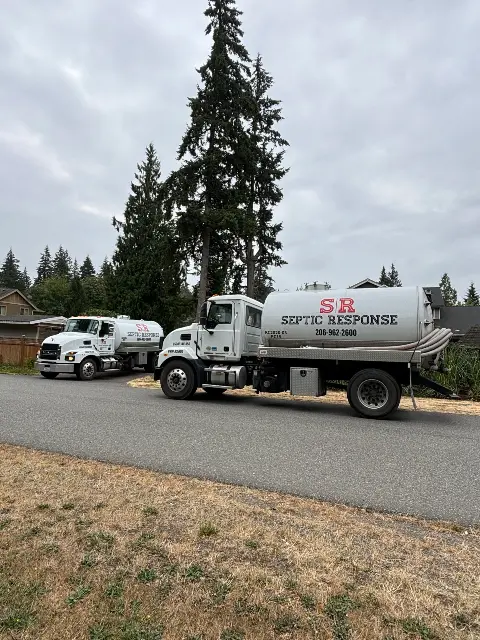
Not sure when your tank was last pumped? Our septic tank pumping page explains what happens on a visit and how often most homes need it.
What septic service costs in Arlington
Routine pumping starts at $590, including a tank and baffle inspection and effluent filter cleaning (when the filter is reachable through a lid or riser), plus the county pumping report fee and tax. Around Arlington, a pump chamber, a mound on acreage or a long gravel drive can add time. We’ll quote it before we come. See our pumping cost page for what goes into a quote.
Booking in Arlington
Our Woodinville crews run north to Arlington regularly. Routine pumping starts at $590, including a tank and baffle inspection and effluent filter cleaning (when the filter is reachable through a lid or riser), plus the county report fee and tax; distance and fuel can add a little out toward Oso or Darrington, and we will tell you up front. Phones are answered 24/7. Repairs carry the Septic Response Promise: a one-year warranty on most repairs, and if you call about our work, we are there the next day if not the same day.
/ Snohomish County
Arlington is in Snohomish County.
Arlington-area septic records are held by the Snohomish County Health Department, with as-builts and reports viewable through OnlineRME.
/ Nearby communities
Do you serve all of Arlington?
Yes. We serve homes and businesses throughout Arlington (98223) and the surrounding area. Not sure? Call (206) 790-9392.
How often should a Arlington septic tank be pumped?
Most Arlington-area households pump every 3 to 5 years. Mound and pressure systems should be inspected every year regardless of when the tank is due. We measure each visit and tell you when the next pumping is due.
Do you file the pumping report?
Yes. We file it with the Snohomish County Health Department after every pumping.
I can’t find my septic tank lid in Arlington. Can you help?
Yes. Locating tanks is routine for us, especially on older Arlington farm and acreage properties. We start from the as-built if one exists, then probe and uncover the lid. We can also install a riser so future pumping is quicker and cheaper.
Why do two Arlington homes nearby have different septic systems?
Soil changes quickly here. Sandy glacial outwash drains well and can support a gravity drainfield, while dense till or a high valley water table usually needs a pressure distribution or mound system. The soil test at the time of permitting decided which one your home got.
Do you serve Oso, Bryant and Lake Riley?
Yes. We serve Arlington (98223) and the surrounding rural areas, including Oso, Bryant, Trafton and Lake Riley. Call (206) 790-9392 to schedule.
Do you serve Arlington Heights and Bryant?
Yes. We serve Arlington (98223) and the surrounding area, including Arlington Heights, Oso, Bryant, Lake Riley and Trafton. Call (206) 790-9392.
How much does septic pumping cost in Arlington?
Routine pumping starts at $590, including a tank and baffle inspection and effluent filter cleaning (when the filter is reachable through a lid or riser), plus the county pumping report fee and tax. Distance and tank size can change the price, and we confirm it before we come.
How often should an Arlington septic system be inspected?
Snohomish County asks owners to inspect gravity systems every three years and alternative systems, such as pressure, mound and ATU systems, every year unless the manufacturer requires more. We file each report with the county for you after the visit.
Why are there so many mound systems around Arlington?
On low valley ground and shallow or dense soils, mounds raise the treatment area so effluent is treated in sand before reaching native soil.
What should I do after a Stillaguamish flood?
Use as little water as possible until the ground drains, then have the system checked before returning to normal use.
Are there septic rebates for Arlington homeowners?
Yes. Snohomish County’s Savvy Septic program offers rebates after the free online Septic Care Workshop.