/ Marysville, Snohomish County
Septic service in Marysville, WA.
Septic pumping, inspections and pump repair for the Marysville area: Getchell Hill and Sunnyside, the lake country around Lake Goodwin, Lake Ki and Lake Cassidy, and the farmland toward the Snohomish River delta. Our Woodinville crews file every pumping report with the Snohomish County Health Department, and the phones are answered 24/7.
Your nearest office
Woodinville
23321 57th Ave SE
Woodinville, WA 98072
(206) 790-9392
Phones answered 24/7
Marysville ZIP codes we serve: 98270
Marysville quick answer
Who services septic systems in Marysville, WA?
Septic Response pumps, inspects and repairs septic systems around Marysville from our Woodinville office. Most of the newer subdivisions are on city sewer; our work is in the homes that aren’t: older houses on Getchell Hill and in Sunnyside, lake homes around Lake Goodwin, Lake Ki and Lake Cassidy, and farms toward the Snohomish River delta. A lot of those systems are 30 to 50 years old and changing hands to owners who have never had septic. Call (206) 790-9392 any hour; an owner answers, and you get the price up front.
- Inspection schedule: set by the Snohomish County Health Department: gravity systems every 3 years; pressure, mound and ATU systems every year. We file the report.
- Buying or selling: since November 1, 2026 a sale needs an inspection from the last 12 months, an as-built or site plan and the county transfer report. Time-of-sale guide.
- A recent Marysville repair: a pressure drainfield was seeping. Roots had grown within 12 inches of the valves in the valve box; we repaired the valves and the field went back to work. No new drainfield needed.
- Routine pumping: from $590 with the baffle check and filter cleaning; county fee and tax extra. What changes the price.
- Where we work: 98270 and the areas around it: Getchell Hill, Sunnyside, Lakewood, Lake Goodwin, Lake Ki, Seven Lakes and the delta. Next door: Arlington, Tulalip and Lake Stevens.
/ Services in Marysville
What we do in Marysville.
Septic Tank Pumping
About an hour on site, with the pumping report filed with the county every time.
Learn more →Septic Inspections
Routine and real-estate inspections, with reports filed within 24 hours.
Learn more →Septic Repair
Effluent pumps, alarms, floats, risers, lids, baffles and filters.
Learn more →Drainfield Repair
Distribution boxes, laterals, drainfield treatment and replacement.
Learn more →Maintenance & Monitoring
Routine O&M checks for pump, pressure and advanced systems.
Learn more →Jetting & Sewer Lines
Camera scoping and replacement of the line from your house to the tank.
Learn more →ATU, Oscar & Bio-Microbics
Aerobic treatment units, including Oscar and Bio-Microbics systems.
Learn more →Septic emergency in Marysville? 24/7 emergency septic service →
/ Septic in Marysville
Older systems, new owners: Marysville septic, sorted.
Marysville has grown fast, and a lot of people moving here are buying a home with a septic system for the first time. Many of those systems were put in decades ago, some have never had a real inspection, and the previous owner’s records are often a shoebox or nothing at all. Here are the questions Marysville homeowners ask us most, and the straight answers.
“Is my house on sewer or septic?”
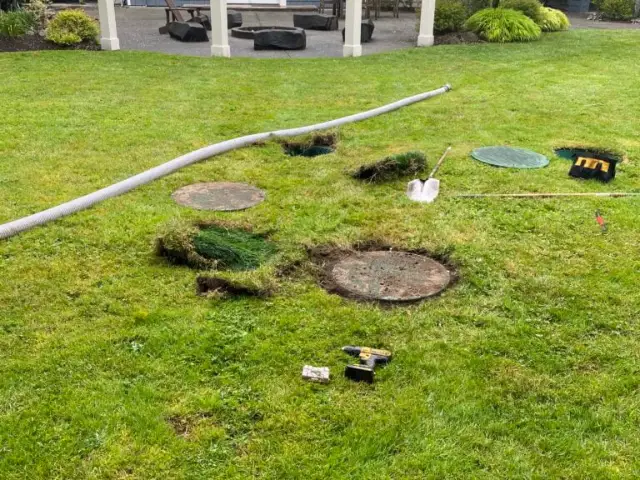
Being inside Marysville city limits doesn’t guarantee sewer. Pockets of older homes, and the unincorporated land around the city, never got sewer lines. The quickest checks: does your utility bill include a sewer charge? Is there a round or square lid, or a green riser, somewhere in the yard? Does the county’s OnlineRME system have an as-built for your address? If you’re still not sure, we can confirm it on site. And if sewer is coming down your street, our septic-to-sewer guide explains the switch, including decommissioning the old tank.
“We just bought an older home on Getchell Hill. What did we get?”
East of town, Getchell Hill and Sunnyside sit on glacial till, dense soil that water moves through slowly. That’s why so many homes there have pressure distribution or mound systems: a pump chamber, an effluent pump, floats and an alarm that push the water out to the field in measured doses. These systems need an inspection every year under county rules, and the pump is the part that fails. In your first year, we recommend:
- Pump the tank and measure sludge and scum, so you know your real schedule.
- Test the effluent pump, floats and alarm, and learn whether your system is timer- or demand-dosed.
- Find the lids and add risers if they’re buried.
- Pull the as-built and keep it with the house papers. Our as-built guide shows where to look.
A timer system sends small doses on a schedule and has reserve space for surges, so back-to-back laundry loads can trip the high-water alarm. If that happens, stop using water and give it a few hours. If the alarm doesn’t clear, call us.
“There are wet spots over the drainfield.”
Wet ground doesn’t automatically mean you need a new drainfield, which is the expensive answer some homeowners get first. On a pressure system, a soggy area often points to something we can fix: a clogged or root-bound lateral, a valve box that’s sending too much water to one line, a pump that’s short-cycling or a tank that’s overdue and sending solids out. On one recent Marysville job, the homeowner’s field was seeping because roots had grown into the valve box. We repaired the valves and the system went back to normal. Our drainfield repair page explains how we diagnose before anyone talks about replacement, and our list of drainfield failure signs helps you tell a minor problem from a serious one.
“We live on Lake Goodwin. Are we hurting the lake?”
A healthy system on a reasonable schedule isn’t. The lakes northwest of town, Lake Goodwin, Lake Ki and Seven Lakes, are ringed with former summer cabins that are now full-time homes, and the ground is mostly sandy glacial outwash. It drains fast, so fields rarely pond, but the effluent also reaches groundwater quickly. A tank full of solids or a system pushed past its design flow has less soil to finish the job before it reaches the lake. What protects the water: pumping on schedule, spreading laundry across the week, getting the inspection done when it’s due, and skipping the additives (here’s why).
“The toilets back up, but the tank isn’t full.”
Then look at the line between the house and the tank. On older Marysville properties, roots, grease and sagging pipe cause more backups than full tanks do. We run a camera down the line to see the problem instead of guessing, then clear it with a jetter or replace the bad section. More on line jetting and replacement and roots in septic lines.
“We want to add an ADU or finish the garage.”
Talk to us before the plans are drawn. A septic system is sized by bedrooms, at least 1,000 gallons for up to four and 250 more for each additional bedroom, and expanding it needs approval from the health officer. Pull the as-built, have the system inspected, and find out what your lot can support before you commit to an addition.
Out on the delta
Toward the Snohomish River delta and the sloughs west of town, the ground is low and the water table rises every winter. Drainfields there have the least margin in the wet months. Keep roof and driveway runoff away from the field, go easy on water during long rainy stretches, and call us if water ever stands over the tank or drainfield.
“The septic alarm went off in the middle of the night.”
On a Getchell Hill or Sunnyside pressure system, the alarm is the system doing its job: it’s warning you that the pump chamber is filling faster than it’s emptying. Don’t panic and don’t ignore it. Stop running water, silence the buzzer, and leave the pump’s breaker on. Look at the control panel; if the pump breaker has tripped, reset it once, and if it trips again, leave it off and call. A timer-dosed system will often catch up overnight with light use. If the alarm is still on in the morning, or it comes back as soon as you start the laundry, the pump, a float or the controls need attention. Call (206) 790-9392 at any hour; one of the owners picks up and will tell you whether it can safely wait for morning. Read more about a septic alarm going off and effluent pump replacement.
“The yard smells like sewage.”
A sewage smell outside has a short list of likely causes, and some are cheap. A lid or riser that doesn’t seal lets tank gases out at ground level. A tank that’s overdue pushes odor and sometimes solids where they shouldn’t be. A wet, smelly patch over the field can mean effluent is reaching the surface, which needs attention quickly, especially near the lakes or where kids and pets play. Odor inside the house is usually a dry trap or a vent problem rather than the tank. We find which one it is before suggesting any repair. See septic smells and what causes them.
“How often should we pump?”
It depends on the tank size, how many people live in the house, and whether you use a garbage disposal. Most Marysville households land somewhere between every three and five years, but older tanks are often smaller than a modern home needs, and a house that went from two people to five changes the math. We measure the sludge and scum on every visit and write your next due date on the report, so you stop guessing. Our pumping frequency guide explains the numbers.
Staying ahead of it
Most of the expensive septic calls we see in Marysville started as small things nobody caught: a float that stuck, a filter that clogged, a tank that went seven years. If you’d rather not keep track yourself, our $10/month maintenance plan covers a free annual filter cleaning and system check, waives emergency fees, guarantees next-day emergency service and takes 10% off septic services, and we remind you when it’s time.
Price and promise
Routine pumping starts at $590, including the tank and baffle inspection and effluent filter cleaning when the filter is reachable, plus the county report fee and tax. A pump chamber that also needs pumping, a long rural drive or a buried lid can add time, and we’ll tell you before we come. Repairs carry the Septic Response Promise: a one-year warranty on most repairs, and if you call about our work, we’re there the next day if not the same day. Complete the county’s free online Septic Care Workshop to qualify for Savvy Septic rebates on inspections, pumping, risers and select repairs.
/ Snohomish County
Marysville is in Snohomish County.
Marysville-area septic permits, as-builts and reports are held by the Snohomish County Health Department. OnlineRME shows the reports we and other contractors have filed for your property.
/ Nearby communities
Do you serve all of Marysville?
Yes. We serve Marysville (98270) and the surrounding area, including Getchell Hill, Sunnyside, Lakewood, Lake Goodwin, Lake Ki, Seven Lakes and the delta farms. Call (206) 790-9392 any hour.
How do I know if my Marysville home is on septic or sewer?
Check your utility bill for a sewer charge, look for a tank lid or riser in the yard, and search Snohomish County’s OnlineRME records for an as-built. Being inside city limits doesn’t guarantee sewer. If you’re unsure, we can confirm it on site.
Do wet spots over my drainfield mean I need a new one?
Not always. On Marysville pressure systems, wet spots often come from a clogged lateral, roots in the valve box, a short-cycling pump or an overdue tank. We diagnose the cause first; replacement is the last option, not the first.
How often should a Marysville septic tank be pumped?
Most households need pumping every 3 to 5 years, depending on tank size, household size and garbage-disposal use. We measure sludge and scum on every visit and tell you when the next pumping is due.
What does Snohomish County require when I sell a Marysville home on septic?
Since November 1, 2026: a full inspection from the last 12 months, pumping if recommended, an as-built or site plan, and a Report of Property Transfer before closing. Older homes are often missing a usable as-built, so start early.
Can I add an ADU on a Marysville property with septic?
Possibly, but the system is sized by bedrooms and expanding it needs health officer approval. Pull your as-built and have the system inspected before planning an addition or ADU.
How much does septic pumping cost in Marysville?
Routine pumping starts at $590, including a tank and baffle inspection and effluent filter cleaning (when the filter is reachable), plus the county pumping report fee and tax. Distance, pump chambers and access can change the price, and we confirm it before we come.
Can I get a rebate for septic work in Marysville?
Yes. Snohomish County’s Savvy Septic Program offers rebates for inspections, pumping, riser installation and select minor repairs once you complete its free online Septic Care Workshop.