
/ Locating your tank
How to find your septic tank lid.
Most tanks sit 10 to 25 feet from the house, in line with where the main sewer pipe leaves the foundation. County records usually show exactly where.
By Anthony Wilson, founder · Updated November 2026

Lots of homeowners have never seen their septic tank. It may be buried under lawn, a flower bed or even a deck. You need to know where it is before a pump-out or inspection, and knowing in advance saves time and digging costs on service day.
Step 1: Check the county as-built drawing
An “as-built” is the drawing filed with the county when the system was installed. It shows the tank, the drainfield and measurements from the house. This is the fastest way to find your tank.
- King County: records are kept by Public Health – Seattle & King County. Our King County as-built guide shows how to search.
- Snohomish County: records are kept by the Snohomish County Health Department. See our Snohomish County as-built guide.
Older homes sometimes have no drawing on file, or a hand-drawn sketch that is only roughly accurate. It is still a great starting point.
Step 2: Find where the sewer line leaves the house
Go to the basement or crawlspace and find the large (usually 3 or 4 inch) pipe that all the drains connect to. Note where it exits the foundation. The tank is almost always in a straight line from that point, typically 10 to 25 feet out.
Step 3: Look for clues in the yard
- Green or plastic riser lids at ground level (the easy case)
- A rectangular area where grass grows differently or snow melts first
- A slight depression or mound
- A cleanout pipe sticking up between the house and the tank
- An alarm box or control panel on the house wall, which usually means a pump tank is nearby
Step 4: Probe carefully
A thin metal soil probe pushed gently into the ground every couple of feet along the sewer line path will hit the concrete lid of the tank, usually 6 to 24 inches down. Do not use a probe near gas lines or buried electrical. Call 811 before you dig anything in Washington.
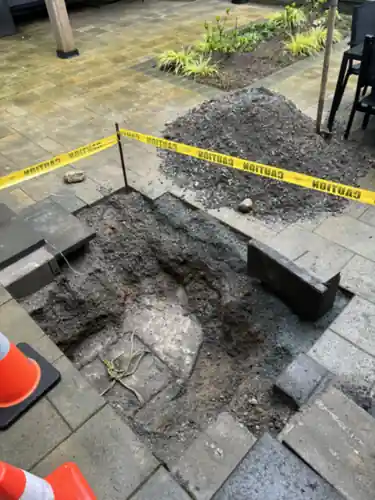
Tanks with more than one lid
Most tanks have two compartments and two lids: one over the inlet and one over the outlet. Pump systems have an extra pump chamber with its own lid. For pumping we need access to all of them.
Should I add risers?
Yes, if your lids are buried. Risers bring the lids up to ground level so you never have to dig again. They make every future pump-out and inspection faster and cheaper, and they help with the county inspection schedule. We install them on most service visits when requested.
Never open a tank alone
Septic lids are heavy, and tanks contain dangerous gases. Never lean into an open tank, and keep children and pets away. Secure lids with screws or locks after service.
If you still can’t find it, call us. We usually find a buried tank with a probe. When there is no county as-built on file, or the tank location is unknown or hard to find, we flush a small transmitter down the line and follow it to the tank with an electronic locator. Members of our maintenance plan get their tank location recorded in their service history so you never have to search again.
Quick answers
How far is a septic tank from the house?
Usually 10 to 25 feet from the foundation, in line with the main sewer pipe. Local codes require a minimum setback from the house.
How deep is a septic tank lid?
Most lids are between 6 and 24 inches below the surface unless risers bring them to ground level. Some older tanks are buried deeper.
Where can I find my septic as-built?
King County as-builts are kept by Public Health – Seattle & King County; Snohomish County as-builts are kept by the Snohomish County Health Department. Both offer online lookups for many properties.
Can a septic company find my tank?
Yes. We start with as-built records and a probe. If there is no as-built or the tank is hard to find, we flush a small transmitter down the line and follow it with an electronic locator.