
/ Septic to sewer
Septic to sewer conversion in King & Snohomish County: the full process.
Short answer: A septic-to-sewer conversion has five parts. Confirm sewer is available to your lot and get it in writing from your sewer provider, find out whether you have to connect, get the fees from that provider, have a licensed contractor install a permitted side sewer from your house to the public main, then have the old septic tank pumped and decommissioned with the abandonment reported to the health department. The order matters, and the sewer provider, not the county health department, sets the fees and the timeline.
By Anthony Wilson, founder · Updated November 2026
There are tens of thousands of septic systems inside sewered parts of our two counties. Public Health – Seattle & King County counts nearly 40,000 in urban King County alone, many of them past their intended life span. When sewer reaches your street, or your septic system starts to fail, the question changes from “how do I keep this running?” to “how do I get off it?” This guide walks through how that actually works in King and Snohomish County, who you deal with at each step, and where Septic Response fits in.
If you’re buying a house and weighing septic against sewer, start with our guide on septic vs. sewer before you buy. This post is for owners who are ready to make the switch.
Step 1: Find out whether sewer is available to your lot
“Sewer on my street” and “sewer available to my house” are not the same thing. What matters is whether a public sewer main is close enough, and whether the utility that owns it will let you connect.
Find your sewer provider. Around here, sewer belongs to either a city or a special-purpose district. Woodinville Water District, Northshore Utility District, Sammamish Plateau Water, Alderwood Water & Wastewater District, and the cities of Kirkland, Redmond, Bothell, Snohomish, Monroe and Marysville all run sewer systems in our service area. In King County, the county’s Septic & Group B records tool shows the sewer district for an address or parcel, and King County iMap shows urban zoning and nearby mains. In Snohomish County, start with your city’s public works department or the county’s list of sewer and water districts.
Ask the 200-foot question. Public Health – Seattle & King County’s sewer connection FAQ tells owners to confirm the distance to the nearest public sewer with the utility and to get it in writing, such as a Sewer Availability Certificate or an email, before collecting cost estimates. In King County the 200 feet is measured along the shortest legal route through road rights-of-way or easements, not in a straight line across the neighbor’s yard.
Ask whether the main can take you. Some streets have a main that sits too high, too far, or on the wrong side of a property line. Sometimes the main has to be extended first, which is the single biggest thing that can push a conversion’s cost up.
Step 2: Do you have to connect?
Most people convert because they want to. Some have to. The rules come from the state, the county and your city or sewer district.
Washington State
Under WAC 246-272A-0025, when an existing septic system fails inside a sewer utility’s service area, the local health officer allows a repair only if a conforming system can be designed and installed. Otherwise the owner must connect if the utility allows it and adequate sewer is within 200 feet. Local boards of health can also require new development to connect.
King County
King County’s Board of Health code goes further. Its sewer connection FAQ (citing KC BOH 13.04.050 and KCC 13.24.136) says you must connect when your property is inside the Urban Growth Area, the utility allows the connection, public sewer is within 200 feet, and you’re doing one of these:
- building a new house or commercial building, or creating new lots;
- repairing or replacing a failing system that can’t be replaced with one that meets current code;
- remodeling or adding on in a way that affects the system, such as adding a bedroom, bathroom or fixtures, expanding the footprint, or building an ADU;
- a middle-housing development.
Cities can add their own requirements on top of this, so check with your city as well.
Snohomish County
The Snohomish County Health Department follows the state rules above for failing systems and abandonment. Cities and sewer districts in the county set their own connection policies, so the sewer provider is the place to ask whether your lot must connect and when.
If connecting would be extremely expensive (for example, it needs a long mainline extension), King County has a waiver from the connection requirement. Waivers are not guaranteed, need an application with a designer’s report, utility documentation and three contractor estimates, and are granted only in extraordinary circumstances. Public Health’s advice is to exhaust every sewer option first.
Step 3: Get the real numbers from your sewer provider
No honest contractor can quote a conversion until the sewer provider has told you what it charges, because a large share of the total belongs to the provider. King County’s FAQ lists the cost pieces you should expect:
- Sewer utility permit fees: plan review, inspection, right-of-way and administrative fees.
- Connection charges: called general facility charges, local facility charges or tap fees depending on the provider. Some areas also have latecomer or local improvement district charges.
- Capacity charge: in areas served by King County’s wastewater treatment system, King County bills a capacity charge to newly connecting customers. Alderwood Water & Wastewater District, for example, notes that King County bills it directly for properties connected on or after February 1, 1990.
- The side sewer itself: installed by a licensed contractor. The price depends on distance, trench depth, and whether the line crosses a road, driveway or right-of-way.
- A mainline extension, if one is needed. This can change the project completely.
- A monthly sewer bill once you’re connected.
These numbers vary a lot from one district to the next, so ask your provider for a written breakdown for your parcel. We’ll cover what drives each piece in the next post in this series.
It also helps to compare against what keeping septic actually costs. King County’s FAQ estimates roughly $66,000 over 30 years for a septic system’s inspections, pumping and one replacement, using 2025 figures. Your numbers will differ, but septic is never free.
Step 4: Permit and install the side sewer
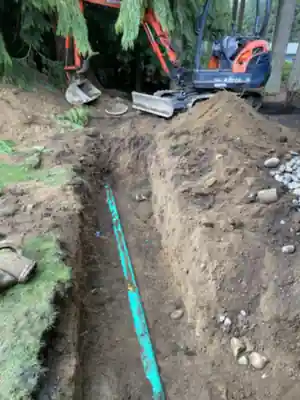
The side sewer is the private pipe that carries everything from your house to the public main. On a septic home, the house’s building drain already runs out to the tank. In a conversion, that line is cut over to a new side sewer running to the main, and the tank is taken out of service.
Who issues the permit: whoever owns the main. That’s the city’s public works department or the sewer district, not the county health department. Each has its own application, standards and inspection. Alderwood Water & Wastewater District’s process is a good example of how it usually goes: request a service connection, get a fee total, pay it, sign the service order, buy the side sewer permit, then call to schedule the inspection before you’re ready to connect. Work can’t start until the permit is issued, and the provider inspects the pipe before the trench is covered.
Who does the work: a licensed contractor. Septic Response is licensed to complete side sewers. We install them ourselves and help you with the permitting, so you aren’t left deciphering a district’s standards on your own. See our side sewer installation page for what’s involved.
When the house sits below the sewer: gravity won’t carry wastewater uphill to the main. Those homes need a sewage ejector or grinder pump to lift it, and we install and repair both.
Before you dig: know where your tank, lines and drainfield are. The as-built drawing shows them. Use our guides for King County as-built records and Snohomish County as-builts. If the old line from the house is cracked or full of roots, it’s worth a camera look before tying it into new pipe; our sewer line crew does camera scoping, jetting and line replacement.
Step 5: Pump and decommission the old septic tank
Connecting to sewer doesn’t make the old tank disappear. An abandoned tank still full of sewage, or a tank with a rotting lid, is a health and safety hazard. Washington’s rule for abandonment, WAC 246-272A-0300, sets three steps:
- Have an approved pumper remove the septage.
- Either remove the tank, or leave it in place with the lid removed or destroyed and the void filled with soil or gravel.
- Grade the site.
King County asks that the abandonment be reported to Public Health on its “Report of wastewater tank abandonment” (kingcounty.gov/septic/abandonment). Its sewer conversion flowchart lists this as part of connecting to sewer. Snohomish County says it has no rules beyond the WAC, and its abandonment guidance follows the same three steps.
This is septic work, and it’s ours. Septic Response pumps the tank, decommissions it, and files the report with the county, so the record shows the system was closed properly. That record matters later: in King County, a system abandoned after connecting to sewer is one of the waivers from the home-sale inspection, and the next buyer’s agent will ask for proof.
Paying for a conversion
- Craft3 Clean Water Loans: King County lists Craft3 as a lender whose loans can cover connecting to public sewer when the county allows it, as well as septic repair and replacement. Low-income homeowners may get special rates and deferred payments. Craft3: 1-888-231-2170.
- Your sewer provider: ask about payment plans, low-interest financing and cost sharing. King County notes that neighbors connecting at the same time can share costs.
- Other King County help: the county’s financial assistance page lists the Housing Repair Program, Habitat for Humanity’s home repair program (which covers septic repair) and USDA Section 504. Check each for current eligibility.
How long a conversion takes
There’s no single answer, because the slow parts belong to the sewer provider: availability letters, fee totals, permit review and inspection scheduling. The field work for a straightforward side sewer and tank decommissioning is the short part of the project. A mainline extension, a road crossing or a pump installation adds time. Our advice: get the provider’s written availability and fee breakdown first, then line up the contractor, so nothing stalls while you wait on paperwork.
Converting while you sell or buy
If a sale is coming, sequence matters. In King County, a home on septic needs an inspection by a certified maintainer before the title transfers, unless a waiver applies, and one waiver is a system that’s been abandoned because the house connected to sewer. In Snohomish County, sellers of septic homes now need a full inspection, a site plan or as-built on file, and a Report of Property Transfer before closing (effective November 1, 2026). If the conversion won’t be finished before closing, plan on the septic paperwork too. Our Snohomish County home-sale guide covers that program.
Where Septic Response fits
Most conversions involve two trades that rarely talk to each other: the septic side and the sewer side. We do both.
- Side sewer installation, done by our own crew, licensed to complete side sewers.
- Permitting help with your city or sewer district.
- Pumping before abandonment with our own fleet of 5 septic pump trucks.
- Decommissioning the old tank and filing the county report.
- Camera scoping, jetting and line replacement for the house line.
- Ejector and grinder pumps when the house sits below the sewer.
Septic Response is family-run since 2017, licensed, bonded and insured (WA license #SEPTIRL810RB), and our phones are answered 24/7. The owners answer the calls, and you get a written price before any work starts. Call our Kirkland office at (206) 962-2600 for King County or our Woodinville office at (206) 790-9392 for Snohomish County.
Quick answers
Do I have to connect to sewer when it reaches my street?
Not always right away. In King County you must connect if you’re in the Urban Growth Area, the utility allows it, sewer is within 200 feet, and you’re building, adding on in a way that affects the system, or your system has failed and can’t be replaced to code. State rules require connection for a failing system within 200 feet of available sewer when a conforming repair isn’t possible. Your city or sewer district may have its own rules.
Who issues the permit for a septic-to-sewer connection?
The owner of the sewer main: your city’s public works department or your sewer district. The health department handles the septic side, including the abandonment record in King County.
What happens to my septic tank after I connect?
It must be pumped by an approved pumper, then removed or filled in place with the lid removed or destroyed, and the site graded (WAC 246-272A-0300). In King County, the abandonment is reported to Public Health. Septic Response does the pumping, decommissioning and report.
How much does it cost to convert from septic to sewer?
It depends mostly on your sewer provider’s fees, the distance and depth of the side sewer, and whether the main has to be extended. Get a written fee breakdown from your provider first, then a contractor estimate for the side sewer and decommissioning.
Can one company do the side sewer and close the septic tank?
Yes. Septic Response installs side sewers, helps with the permit, and pumps and decommissions the old tank, with the county report filed for you.
Sources: Public Health – Seattle & King County, Resources to understand septic to sewer conversions, Sewer Conversion Flowchart and Sewer Connection FAQ; King County financial assistance; WAC 246-272A-0025; WAC 246-272A-0300; Snohomish County Health Department septic FAQs; Alderwood Water & Wastewater District service connection.