
/ Redmond, King County
Septic service in Redmond, WA.
Septic pumping, inspections and repairs for homes and businesses in Redmond, from our Kirkland office. We file every pumping report with Public Health – Seattle & King County for you, and our phones are answered 24/7.
Your nearest office
Kirkland
672 7th Ave
Kirkland, WA 98033
(206) 962-2600
Phones answered 24/7
Redmond ZIP codes we serve: 98052, 98053
/ Services in Redmond
What we do in Redmond.
Septic Tank Pumping
About an hour on site, with the pumping report filed with the county every time.
Learn more →Septic Inspections
Routine and real-estate inspections, with reports filed within 24 hours.
Learn more →Septic Repair
Effluent pumps, alarms, floats, risers, lids, baffles and filters.
Learn more →Drainfield Repair
Distribution boxes, laterals, drainfield treatment and replacement.
Learn more →Maintenance & Monitoring
Routine O&M checks for pump, pressure and advanced systems.
Learn more →Jetting & Sewer Lines
Camera scoping and replacement of the line from your house to the tank.
Learn more →ATU, Oscar & Bio-Microbics
Aerobic treatment units, including Oscar and Bio-Microbics systems.
Learn more →Septic emergency in Redmond? 24/7 emergency septic service →
/ Septic in Redmond
Beyond downtown, Redmond runs on septic.
Downtown Redmond, Overlake and most of the city’s neighborhoods are on sewer. The septic homes are just outside them, and there are a lot of them: Union Hill, Novelty Hill, the acreage around Redmond Ridge, the horse properties of the Bear Creek and Evans Creek valleys, and the older lots on the edges of Education Hill and toward Woodinville and Sammamish. North Redmond addresses near Hollywood Hill have much in common with their neighbors covered on our Woodinville septic pumping page: glacial till, wet winters and pressure systems. Much of this area is unincorporated King County with a Redmond address, and many of these homes are on two acres or more.
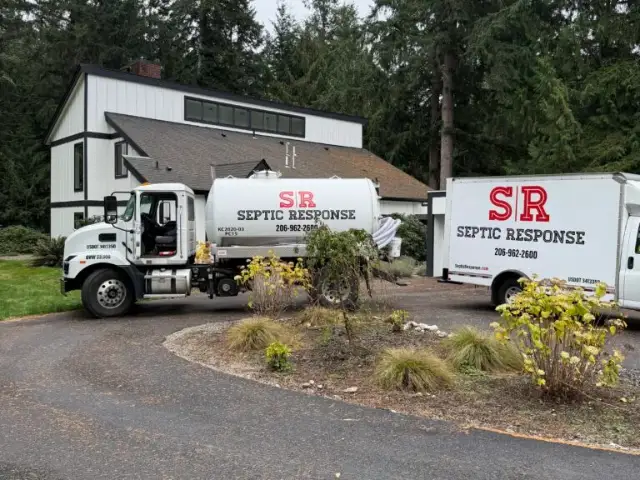
Redmond’s ground
Union Hill and Novelty Hill rise above the Sammamish River valley on dense glacial till. Rain sits on top of it all winter, and drainfields here are designed around that. You will find a lot of pressure distribution and mound systems on the hills, each with an effluent pump, floats and an alarm.
Below them, Bear Creek and Evans Creek run through valleys with high winter groundwater, and both are important salmon streams. Systems near the creeks have to work as designed, which is why King County inspects alternative systems more often and why we take drainfield problems in these valleys seriously.
What Redmond homeowners call us for
- Routine pumping with measurements, so you know when you are actually due.
- Effluent pump and float replacement on Union Hill and Novelty Hill pressure systems.
- Alarm calls at any hour, when a pump chamber stops draining.
- Inspections on King County’s schedule, and before a sale.
- Drainfield evaluation and repair when a system starts surfacing or slowing down in wet months.
- ATU service for aerobic treatment units on tighter or sensitive lots.
Large lots, long lines
On big Redmond properties the tank can be a long way from the house, and the drainfield farther still. Lids get buried under lawn or pasture, and the line between the house and the tank picks up roots. We locate tanks, add risers so the next pumping is simple, and jet and camera-scope lines that keep backing up.
King County rules in Redmond
Redmond-area homes follow Public Health – Seattle & King County rules: gravity systems inspected every three years, pressure, mound, sand filter and ATU systems more often under the county schedule, and a certified inspection before the title transfers on a sale. We file every report. Most Redmond-area as-builts are in King County’s online records; see our as-built guide.
Redmond neighborhoods at a glance
- Union Hill: acreage on dense glacial till, where pressure distribution and mound systems are common and pumps and floats are the usual repairs.
- Novelty Hill and the Redmond Ridge surroundings: larger lots outside the planned neighborhoods, many on pressure systems.
- Ames Lake: lake-area homes toward Carnation, where the shoreline and water table limit the drainfield.
- Bear Creek and Avondale: horse and hobby-farm properties in the creek valley, with long lines to the tank and high winter groundwater.
- Education Hill edges: older homes on the fringes of the city that were never connected to sewer.
Protecting a drainfield on a large Redmond lot
On big properties the drainfield is easy to forget. Keep vehicles, horses, trailers and new structures off it, send downspouts and driveway runoff away from it, and keep deep-rooted trees at a distance. If you are not sure where the field is, the as-built shows it, and we can confirm it on site so it does not get damaged by a future project.
Buying or selling in Redmond
King County requires an inspection by a certified on-site system maintainer before the title transfers, unless a waiver applies, and we file the report for you. For a Union Hill or Novelty Hill property, ask what type of system it is, how old the effluent pump is, and when the last operation and maintenance inspection was filed. Horse properties should also be checked for traffic or structures over the drainfield. Sellers can avoid last-minute delays by booking the inspection as soon as the listing is planned.
Timer-dosed systems on Union Hill and Novelty Hill
Many of the pressure and mound systems on Redmond’s hills are time-dosed. A timer in the control panel runs the effluent pump for short, set periods through the day and night, and the pump chamber stores the rest. That keeps the drainfield from getting hit with a whole morning’s showers and laundry at once, which is exactly what slow glacial till needs. Other homes have demand-dosed systems, where floats start the pump whenever the chamber fills to a set level.
Knowing which one you have tells you what an alarm means. On a time-dosed Union Hill system, a high-water alarm after guests, laundry day or a week of atmospheric-river rain often means the chamber filled faster than the timer empties it. Cut water use to a minimum, silence the buzzer without switching off the pump, check the breaker, and give it a few hours: the alarm often clears as the timer catches up. If it does not, or it comes back with normal use, the pump, a float, the timer or groundwater getting into the tank needs a look. On a demand system, the pump should already be running before the alarm sounds, so an alarm usually means a failed pump, a stuck float or a tripped breaker, and it is time to call. Our septic repair page compares the two.
Finding and reaching tanks on big Redmond lots
On acreage off Redmond-Fall City Road, Avondale Road or Novelty Hill Road, the septic tank can be well over a hundred feet from the driveway, under pasture, lawn or a garden that went in after the system did. We start with the county as-built and usually probe for the tank from where the sewer line leaves the house. If there is no as-built, or the tank is unknown or hard to find, we use an electronic locator with a flushable transmitter. We carry enough hose for every job, so the truck stays on the driveway instead of rutting a soggy pasture. Once the lids are found, a riser brings them to the surface so you never have to dig for them again.
ATUs and sand filters near Bear and Evans creeks
On tighter lots and sites close to Bear Creek and Evans Creek, some Redmond homes have aerobic treatment units or sand filters that clean the effluent more thoroughly before it reaches the soil. These systems have more parts: a blower or aerator, filters, pumps, floats and an alarm, and King County lists them for inspection every 6 months unless the manufacturer requires more often. Never switch off an ATU’s blower to save power, keep the alarm connected, and go easy on harsh cleaners and long courses of medication, which King County notes can kill the bacteria the system relies on. If you are buying a home with one, our guide to buying a home with an ATU covers what to check.
What happens on a Redmond pumping visit
Routine pumping includes more than emptying the tank. Before we pump, we measure the sludge and scum layers; King County’s rule of thumb is that a tank is due when the bottom of the scum is within 3 inches of the bottom of the outlet baffle, or the sludge is within 12 inches of the outlet fitting. We inspect the tank and its inlet and outlet baffles, which hold scum and solids back from the drainfield and are often corroded on older concrete tanks. We clean the effluent filter when it can be reached through a lid or riser. Then we file the pumping report with the county, so your record stays current.
When sewer reaches the edge of town
Some older homes on the edges of Education Hill and the valley now sit near a sewer main. Washington’s rules say that if a septic system fails inside a sewer utility’s service area and sewer is available within 200 feet, the owner can be required to connect unless a conforming septic repair can be designed (WAC 246-272A-0025). If you do connect, the old tank has to be pumped and properly abandoned. We decommission old tanks and file the county report for you. Our septic vs. sewer guide explains the trade-offs for buyers.
Paying for larger repairs
A worn effluent pump or failed float is a manageable repair. A drainfield replacement on a Union Hill lot is not. King County’s financial assistance page lists a septic maintenance and side sewer repair rebate program, Craft3 Clean Water Loans that can cover the full cost of eligible design, permitting and installation, and programs for lower-income homeowners. Staying on the county inspection schedule is the best way to catch a pump or baffle problem before it becomes a drainfield problem. Our $10/month maintenance plan includes a free annual filter cleaning and system check, waives emergency fees and takes 10% off septic services.
Roots from Redmond’s big trees
Many Redmond-area lots were carved out of second-growth forest, and the Douglas firs, cedars, maples and cottonwoods left standing are often older than the houses. Their roots go looking for moisture, and a septic line with a cracked joint or an old clay section is an easy target. The usual sign is a slow main drain or a backup that clears after jetting and then returns a few months later. A sewer camera shows exactly where the roots are getting in, and replacing that section closes the entry point for good. Keep new trees and large shrubs well away from the tank, the line and the drainfield; King County recommends grass or shallow-rooted plants over the field. Our guide to tree roots in septic lines covers the warning signs and fixes.
How often should a Redmond septic tank be pumped?
There is no single answer, and that is why we measure instead of guessing. A couple in a large Novelty Hill home with a 1,250-gallon tank may go years longer than a family of five with a 1,000-gallon tank and a busy kitchen. King County’s guidance is that tanks usually need pumping every 3 to 5 years, with larger households needing it more often, and that the measurements taken at an inspection are what should decide it. If you do not know when your tank was last pumped, check your county records or call us; it is probably due. Our pumping schedule guide explains how to work it out.
Recent Redmond job: sand filter inspection and pumping
At a Redmond home with a sand filter system, we were called out for a routine inspection, and we ended up pumping the septic tank on the same visit. A sand filter adds a treatment step after the septic tank, so its routine checks and the tank’s pumping schedule go hand in hand. Our septic maintenance and monitoring page covers what a routine visit includes.
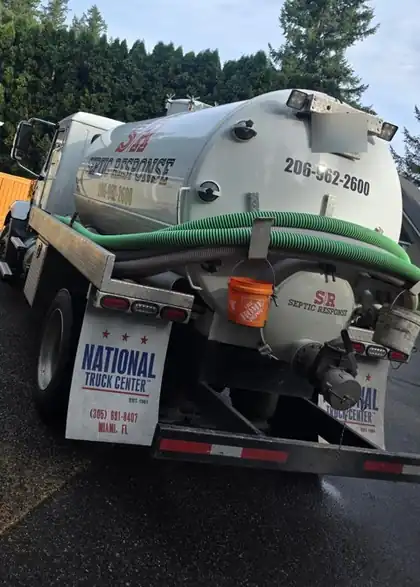
Recent Redmond job: AdvanTex pod cleaning
Not every visit starts with a problem. At a Redmond home with an Orenco AdvanTex treatment system, we did the pod cleaning that this system needs every two years as part of its maintenance. The pod holds textile filter media that treats the effluent, and over time it collects buildup that slows the flow. We cleaned the textiles along with the other components inside the pod so the system keeps flowing and treating properly.
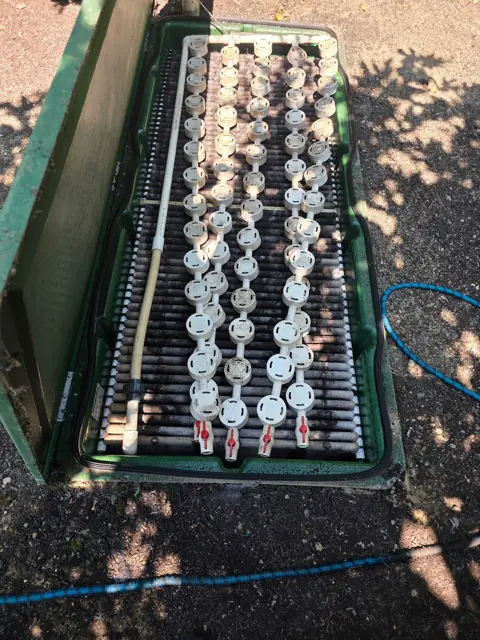
If your home has an advanced treatment system, it needs scheduled maintenance like this, not just pumping. Our ATU and advanced system service page covers AdvanTex, Oscar and Bio-Microbics maintenance.
Recent Redmond job: alarm on and the pump breaker tripped
A Redmond homeowner called us early one morning. Their septic alarm was going off, and the breaker for the septic pump had tripped. We walked them through some troubleshooting over the phone, which pointed to a failed pump or float. Our crew went out the same day, checked the power and took voltage and amp readings on the pump circuit, and confirmed the pump itself had failed. We replaced the pump and the float and had the system running again that day.

If your alarm is on and the pump breaker keeps tripping, don’t keep resetting it; call us. Our guide to a septic alarm going off explains what the alarm means and what to do while you wait.
What septic service costs in Redmond
Routine pumping starts at $590, including a tank and baffle inspection and effluent filter cleaning (when the filter is reachable through a lid or riser), plus the county pumping report fee and tax. Redmond is minutes from our Kirkland office. Large tanks, long access and buried lids can change the price, and we tell you before we start. See our pumping cost page for what goes into a quote.
Service from our Kirkland office
Our Kirkland office is minutes from Redmond, and our crews are on Union Hill and Novelty Hill regularly. Routine pumping starts at $590, including a tank and baffle inspection and effluent filter cleaning (when the filter is reachable through a lid or riser), plus the county pumping report fee and tax. Phones are answered 24/7. Every repair carries the Septic Response Promise: a one-year warranty on most repairs, and if you call about work we have done, we are there the next day if not the same day.
/ King County
Redmond is in King County.
King County requires owners to keep septic systems maintained and inspected on a schedule that depends on the system type. We file pumping reports with Public Health – Seattle & King County and inspection reports within 24 hours, so your records stay current.
/ Nearby communities
Do you serve all of Redmond?
Yes. We serve homes and businesses throughout Redmond (98052, 98053) and the surrounding area. Not sure? Call (206) 962-2600.
How often should a Redmond septic tank be pumped?
Most households need pumping every 3 to 5 years, depending on tank size, household size and garbage-disposal use. We measure sludge and scum on every visit and tell you when the next pumping is due.
Do you file the pumping report?
Yes. We file it with Public Health – Seattle & King County after every pumping.
Which Redmond areas are on septic?
Most of the city proper is on sewer. Union Hill, Novelty Hill, the Bear Creek and Evans Creek valleys, parts of Redmond Ridge’s surroundings and older lots on the city’s edges are largely on septic, much of it unincorporated King County with a Redmond address.
How often does a Redmond pressure or mound system need inspection?
King County inspects gravity systems every three years and alternative systems such as pressure, mound, sand filter and ATU systems more often under its schedule. We can tell you exactly what your system needs and file the report with the county.
Do you serve Union Hill and Novelty Hill?
Yes, along with the rest of the Redmond area. Call our Kirkland office at (206) 962-2600; we answer 24/7.
Do you serve Ames Lake and Avondale?
Yes. We serve the whole Redmond area (98052 and 98053), including Union Hill, Novelty Hill, Ames Lake, Bear Creek and Avondale. Call (206) 962-2600.
How much does septic pumping cost in Redmond?
Routine pumping starts at $590, including a tank and baffle inspection and effluent filter cleaning (when the filter is reachable through a lid or riser), plus the county pumping report fee and tax. Tank size and access can change the price, and we confirm it before we come.
Do Redmond pressure systems need more maintenance than gravity systems?
Yes. A pressure system has an effluent pump, floats, a control panel and an alarm that all have to keep working, and King County inspects these systems more often than simple gravity systems. Regular service catches a worn float or pump before it causes a backup.
Why does my Union Hill septic alarm go off after heavy rain?
On many Union Hill and Novelty Hill pressure systems a timer controls the pump, so if more water enters the tank than the timer sends out, the level rises and trips the alarm. Cut water use and give it a few hours. If the alarm does not clear, or groundwater may be leaking into the tank, call for service.
How often does a Redmond pressure or mound system need inspection?
King County lists gravity systems every 3 years and pressure distribution, mound, sand filter, ATU and drip systems every 6 months, unless the manufacturer requires more often.
Can you find my septic tank on a large Redmond property?
Yes. We start with the county as-built and usually probe for the tank. If there is no as-built or the tank is hard to find, we use an electronic locator with a flushable transmitter, and we carry enough hose for every job.