
/ Service
Septic effluent pump replacement in King & Snohomish County
Septic effluent pump repair and replacement for pressure, mound, sand filter, drip and pump-to-gravity systems in every city across King and Snohomish County. We test the floats, panel and wiring before we condemn a pump, and you get the price before we start. Phones answered 24/7.
Septic alarm going off?
We answer 24/7
Cut water use, silence the buzzer (leave the power on), check the pump breaker, then call.
Kirkland (206) 962-2600
Woodinville (206) 790-9392
/ Septic effluent pumps
Short answer: an effluent pump moves wastewater out of your septic system’s pump chamber to the drainfield. When it fails, nothing reaches the drainfield, the chamber fills, and the high-water alarm sounds. Septic Response repairs and replaces effluent pumps, floats, control panels and alarms in every city we serve in King and Snohomish County. We find out whether it is really the pump before we replace anything, and you get the price before we start.
- What we do: diagnose pump, float, breaker, timer and wiring problems; replace turbine and submersible effluent pumps; replace floats, alarms and control panels; clean pump vault screens; and pump down a flooded chamber.
- Where: every city in both counties. King County calls go to our Kirkland office, (206) 962-2600; Snohomish County calls go to Woodinville, (206) 790-9392. Both answered 24/7, by the owners.
- Alarm going off right now? Cut your water use, silence the buzzer but leave the power on, and check the pump breaker. See what to do in the next hour.
- Pricing: it depends on the pump your system was designed for and what else is worn, so we look first and give you the number before any work starts. Most repairs carry the Septic Response Promise, a one-year warranty.
What does a septic effluent pump do?
A septic tank does the first round of treatment. Solids settle, scum floats, and the clearer liquid in the middle, called effluent, flows on. On a simple gravity system that effluent runs downhill to the drainfield on its own. A lot of homes around here can’t do that.
When the drainfield sits uphill from the tank, when the soil is too tight or too wet for a gravity trench, or when the design calls for small, even doses spread across the whole field, the system has a second compartment or a separate tank called a pump chamber. Effluent collects there, and an effluent pump sends it out through a pressure line to the drainfield, mound, sand filter or drip field. Floats or a timer in the control panel decide when it runs. A high-water float sets off the alarm if the level climbs too far.
That makes the effluent pump the one moving part the whole system depends on. A gravity system can limp along for months with a problem. A pump system with a dead pump stops working the same day.
Which homes in King and Snohomish County have one?
More than most people think. Our area’s glacial till, high winter water tables and steep lots mean a large share of the septic systems we service are pump systems. A few patterns we see every week:
- The till plateaus east of Lake Washington. Union Hill and Novelty Hill in Redmond, the Sammamish plateau, Hollywood Hill in Woodinville and the acreage around Cottage Lake. Rain sits on dense till all winter, so many of these homes have pressure distribution systems or mounds, each with an effluent pump.
- River valleys with high water tables. The Snoqualmie Valley around Carnation, Duvall and Fall City, and the Snohomish and Pilchuck valleys around Snohomish, Monroe and Machias. A mound or sand filter lifts treatment above the groundwater, and a pump gets the effluent up there.
- Lake lots. Homes around Lake Stevens, Lake Roesiger, Lake Goodwin and the smaller lakes often have tight setbacks and treatment systems, including aerobic treatment units that end in a pump.
- Uphill drainfields. Anywhere the house sits low and the only good soil is up the slope, from Maple Valley to Granite Falls, a pump-to-gravity design sends effluent uphill to a distribution box.
Not sure what you have? An alarm box on the side of the house or garage, a control panel with a timer, or a second riser lid near the tank usually means a pump chamber. Your as-built drawing will show it. Our guides to King County as-built records and finding a Snohomish County as-built explain where to look.
Effluent pump, sewage ejector pump or sump pump?
All three sit in a basin and all three have floats, so they get mixed up. They do different jobs, and swapping one for another is a common and expensive mistake.
| Septic effluent pump | Sewage ejector pump | Sump pump | |
|---|---|---|---|
| What it moves | Settled effluent from the septic tank | Raw sewage, solids and all | Groundwater and rainwater only |
| Where it sits | Pump chamber after the septic tank, often in a screened vault | Sealed basin in a basement or crawl space | Sump pit in a basement or crawl space |
| Where it sends it | Drainfield, mound, sand filter or drip field | Up to the side sewer or the septic tank | Away from the house, never into the septic system |
| Sized for | The system design: lift, line length, dose volume and pressure | The fixtures and the lift to the sewer | The water coming in |
An effluent pump is built to run in septic effluent for years and to deliver a specific flow at a specific pressure. A sump pump from the hardware store is not, and it will not dose a pressure drainfield properly even if it fits in the chamber. If your home pumps raw sewage up from a basement bathroom, that is an ejector pump; see our sewage ejector and grinder pump page.
Signs your effluent pump is failing
- The high-water alarm is on and doesn’t clear after a few hours of light water use.
- The pump breaker trips, or trips again as soon as you reset it.
- The pump runs and runs without shutting off, or you can hear it cycling on and off every few minutes.
- It hums but doesn’t pump, or makes grinding or rattling noises from the riser.
- Slow drains or gurgling in the lowest fixtures, especially after laundry.
- Wet ground or odor around the tank lids, or soggy spots in one part of the drainfield while the rest stays dry.
- A higher power bill with no other explanation, which can mean a pump running far longer than it should.
None of these prove the pump itself is bad. A stuck float, a failed timer or a corroded splice can cause every one of them. That is why we test before we replace.
Alarm going off? What to do in the next hour
- Cut water use. No laundry, dishwasher or long showers. The chamber has a reserve above the alarm level, and every gallon you hold back buys time.
- Silence the buzzer, not the system. Use the silence or test switch on the alarm box. Leave the pump’s power on.
- Check the breaker. If the pump breaker has tripped, reset it once. If it trips again, leave it off and call us.
- Watch it. On a timer-dosed system, a heavy laundry day or a week of hard rain can set off the alarm even when the pump is fine, and it often clears within a few hours of light use. On a float-controlled system, the pump should already be running, so an alarm usually means it isn’t.
- Call us if it doesn’t clear, keeps coming back, or you see water at the lids. Kirkland (206) 962-2600 or Woodinville (206) 790-9392, any hour.
Our article on a septic alarm going off goes through this in more detail, and the timer vs. float dosing section of our repair page explains why the two systems behave differently.
Is it really the pump? What we check first
Replacing a good pump does not fix a bad float. Before we recommend a new pump, we work through the whole circuit from the house to the chamber:
- Power. The breaker, any GFCI, and the voltage reaching the panel.
- The control panel. Contactors, the hand-off-auto switch, the alarm circuit, and on time-dosed systems the timer settings and any elapsed-time or cycle counters.
- Floats. Each float’s action and position: the off float, the on float or timer-enable float, and the high-water alarm float. Floats tangle, get stuck against the pump or the vault, and fail electrically.
- The splice box in the riser. Wires and floats are joined in a junction box near the top of the riser. In our wet climate, a corroded or flooded splice is a common cause of a pump that won’t start.
- The pump itself. Amp draw while running, whether it actually moves water, and whether it is pumping against a blocked line.
- The pump vault screen and discharge. A clogged screen starves the pump. A frozen or broken discharge line, a stuck check valve or a closed valve makes it run against nothing.
Sometimes the answer is simple, like a float caught on the power cord. Sometimes it is a float, a timer or a panel, not the pump. A Woodinville homeowner called us about a septic pump that would not shut off even with the chamber empty. A pump that runs dry overheats and wears out quickly, so we went out the same day. The pump was fine; the float that tells it when to stop had failed. We replaced the float and the system was back to normal.
Recent effluent pump replacements
A Redmond homeowner called early one morning: the septic alarm was going off and the pump breaker had tripped. We walked them through a few checks over the phone, which pointed to the pump or a float. Our crew went out the same day, checked the power and took voltage and amp readings on the pump circuit, and confirmed the pump had failed. We replaced the pump and the float and had the system dosing again that day. (Read the Redmond job.)
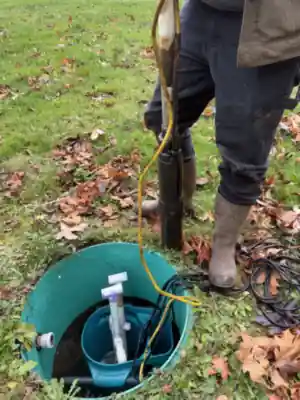
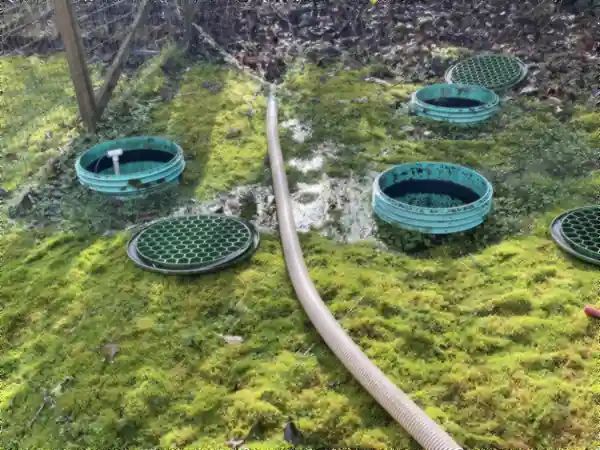
More photos from recent pump jobs are on the way. Each city page also has recent job notes from that area, like the Woodinville float replacement.
Repair it or replace the pump?
We give you the options and the honest answer. As a rule of thumb:
- Repair when the pump tests good and the problem is a float, the splice box, the alarm, a timer setting or a clogged vault screen. Those are usually smaller jobs and the pump has life left.
- Replace when the pump won’t run on good power, draws far more current than its rating, trips the breaker, has seized, or barely moves water. A pump that has failed once from overheating or running dry usually isn’t worth nursing along.
- Replace the floats with the pump when they are original to an older system. A new pump on worn floats is a callback waiting to happen.
- Look at the panel on older systems. A corroded contactor or a timer that has drifted can cook a brand-new pump.
How long do they last? Many effluent pumps run around seven to ten years, and some much longer. Run time is what wears them out: a pump that runs too often because of leaky fixtures, groundwater getting into the tank, or a clogged screen will fail sooner.
Turbine or submersible: matching the pump to your system
Effluent pumps are not one-size-fits-all. Your system was designed for a pump that delivers a certain flow at a certain pressure, and the replacement has to match it.
Turbine effluent pumps
A turbine pump stacks several small impellers to build higher pressure. It is the usual choice for pressure distribution laterals, mounds, sand filters and drip fields, where effluent has to come out of small holes under pressure across the whole field. Turbine pumps normally sit inside a pump vault, a screened housing that keeps solids and scum away from the intake.
Submersible effluent pumps
A single-stage submersible moves more water at lower pressure. It is common on pump-to-gravity systems, where the job is lifting effluent uphill to a distribution box rather than pressurizing laterals. These often sit on a block in the chamber, sometimes with a screened intake or filter.
Why the size matters
Three numbers decide the right pump: how high it has to lift the effluent from the chamber to the drainfield, how long and what size the discharge line is, and the flow and pressure the field was designed for. An undersized pump won’t reach the far ends of the laterals, so part of the drainfield does all the work and wears out early. A pump that is far too big can push too much at once. We work from your as-built and the existing equipment, and if the original design isn’t on file we measure it.
What happens when we replace an effluent pump
- Confirm the diagnosis. Power, panel, floats and splice box tested, so you are paying for the right part.
- Pump down if needed. A flooded chamber is pumped down with our truck so the work is clean and the old pump can come out safely. If the tank is due, it often makes sense to pump the septic tank on the same visit.
- Pull the old pump. It comes up through the riser, usually by opening a union in the discharge line and lifting the pump and vault assembly.
- Clean and inspect. We clean the vault screen and check the discharge line, check valve or anti-siphon parts, and the float tree.
- Install the matched pump. New pump, new floats where needed, and a sealed, dry splice.
- Set and test. We set float levels, confirm timer on and off times on a time-dosed system, run the pump, check amp draw, and trip the alarm so you know it works. On pressure systems we look at how the laterals are taking the dose.
- Leave you the details. What we replaced, the pump model, and the settings, so the next service visit starts with good records.
King County and Snohomish County rules
Pump systems are on shorter inspection schedules than gravity systems in both counties. King County lists pressure, mound, sand filter, aerobic and drip systems for inspection every six months, and Snohomish County lists alternative systems every year. Routine replacement of a worn pump with the right equivalent is part of keeping a system working; larger changes to a system can need county approval under Washington’s septic rules, WAC 246-272A-0270. If your job needs a permit or a report filed, we tell you up front.
Selling a home with a pump system? A failing pump or alarm will show up on the inspection. In Snohomish County, where an inspection is now required for most home sales, see our home sale inspection guide; for King County, see septic inspections.
Power outages and your effluent pump
When the power goes out in a windstorm, the effluent pump stops and the chamber starts filling. The reserve space above the alarm level is meant for exactly this, but it is not unlimited. During an outage, keep water use to a minimum. When the power comes back, the alarm may sound for a while as the chamber pumps down; on a time-dosed system that can take several hours. If it doesn’t clear by the next day, call us. Homes on generators should have the pump circuit on the generator panel, and anyone running a portable generator should have an electrician set up the connection. Our power outage guide has more.
How to make an effluent pump last
- Never unplug or disconnect the alarm. It is your early warning.
- Fix leaks. A running toilet can send hundreds of gallons a day through the pump.
- Spread out laundry instead of doing it all on one day.
- Keep solids out. Wipes, grease and paper towels clog vault screens. See what not to flush.
- Pump the tank on schedule so sludge and scum don’t reach the pump chamber. Our guide to how often to pump covers the timing.
- Have the screen and floats checked at each inspection. On our $10/month maintenance plan, the free annual filter cleaning and system check is a good time to look over the pump, floats and alarm, and there are no emergency fees if the pump quits on a Sunday night.
Effluent pump service in every city we serve
Pump systems are in every corner of both counties, from the till plateaus east of Lake Washington to the river valleys and lake country of Snohomish County. King County calls go to our Kirkland office, (206) 962-2600, and Snohomish County calls go to our Woodinville office, (206) 790-9392.
King County
Kirkland · Bellevue · Redmond · Sammamish · Issaquah · Woodinville · Cottage Lake · Seattle · Shoreline · Newcastle · Renton · Kent · Auburn · Federal Way · Burien · Tukwila · SeaTac · Covington · Maple Valley · Hobart · Duvall · Carnation · Fall City · Snoqualmie · North Bend
Snohomish County
Bothell · Everett · Edmonds · Lynnwood · Mukilteo · Mountlake Terrace · Brier · Woodway · Mill Creek · Martha Lake · Silver Firs · Eastmont · Maltby · Clearview · Snohomish · Machias & Three Lakes · Lake Stevens · Marysville · Tulalip · Arlington · Stanwood · Granite Falls · Monroe · Sultan · Gold Bar · Index · Darrington
Why homeowners call Septic Response for pump problems
- The owners answer every call, day or night, and tell you honestly whether it is an emergency or can wait until morning.
- We test before we replace. You pay for the part that actually failed.
- Transparent pricing. You get the price before we start, with the options if there is more than one fix.
- We stand by our work. Most repairs carry a one-year warranty under the Septic Response Promise.
- Our own trucks. With five pump trucks of our own, we can usually pump down a flooded chamber on the same visit instead of sending a second company.
- Family owned since 2017, with offices in Kirkland and Woodinville and 280 Google reviews across both.
Pump alarm on, breaker tripping, or a pump that won’t stop? Call Kirkland at (206) 962-2600 or Woodinville at (206) 790-9392, or schedule service online. For other septic problems, see septic repair and emergency septic service.
/ Where
Serving both counties.
Our Kirkland office covers King County and our Woodinville office covers every city in Snohomish County.
/ FAQ
What is a septic effluent pump?
A pump in your septic system’s pump chamber that sends settled effluent from the tank to the drainfield, mound, sand filter or drip field. Floats or a timer in the control panel tell it when to run, and a high-water float sets off the alarm if the level gets too high.
How do I know if my effluent pump has failed?
The usual signs are a high-water alarm that won’t clear, a pump breaker that trips, a pump that hums but doesn’t move water or never shuts off, and water or odor at the tank lids. A stuck float, timer or wiring problem can cause the same signs, so we test before replacing the pump.
My septic alarm is going off. What should I do?
Cut water use right away, silence the buzzer but leave the pump’s power on, and check the pump breaker. If it trips again, leave it off. On a timer-dosed system the alarm can clear on its own after a few hours of light use; if it doesn’t, or you see water at the lids, call us. We answer 24/7.
How long does a septic effluent pump last?
Many effluent pumps last around seven to ten years, and some much longer. Run time is what wears them out, so leaks, groundwater getting into the tank and clogged vault screens shorten their life.
Can I replace a septic effluent pump with a sump pump?
No. An effluent pump is built to run in septic effluent and is sized to deliver the flow and pressure your drainfield was designed for. A sump pump won’t dose a pressure system properly and won’t last in effluent.
Do you replace the floats when you replace the pump?
When the floats are worn or original to an older system, yes, we recommend it, because a new pump on failing floats often leads to another call. If the floats test good, we leave them.
How much does effluent pump replacement cost?
It depends on the pump your system was designed for, whether the floats, panel or splice box also need work, and whether the chamber needs pumping down first. We diagnose first and give you the price before any work starts.
Will my pump work during a power outage?
No. The pump stops and the chamber fills. Keep water use to a minimum until power returns, then expect the alarm to sound for a while as the chamber pumps down. If it hasn’t cleared by the next day, call us.
Do you service effluent pumps in my city?
Yes, in every city in King and Snohomish County. King County calls go to our Kirkland office, (206) 962-2600, and Snohomish County calls go to our Woodinville office, (206) 790-9392. Both are answered 24/7.